
In our quarterly Fund Discovery series, we delve into current market conditions and provide insights and strategies to diversify your portfolio.
Listen and subscribe to the podcast hosted by RHB Bank’s Head of Investor Advisory, Nova Lui, to stay updated on the latest market developments.
Global markets closed 2025 with an unexpected twist. Instead of moving in sync, equity markets diverged sharply in the last quarter of the year, creating what some describe as a “Tale of Two Asias”. Two vastly different stories, two separate paths. Going into 2026, understanding these shifts is essential to planning your strategy. In the bigger picture, market leadership is changing, capital flows are evolving, and diversification is becoming more important than ever.
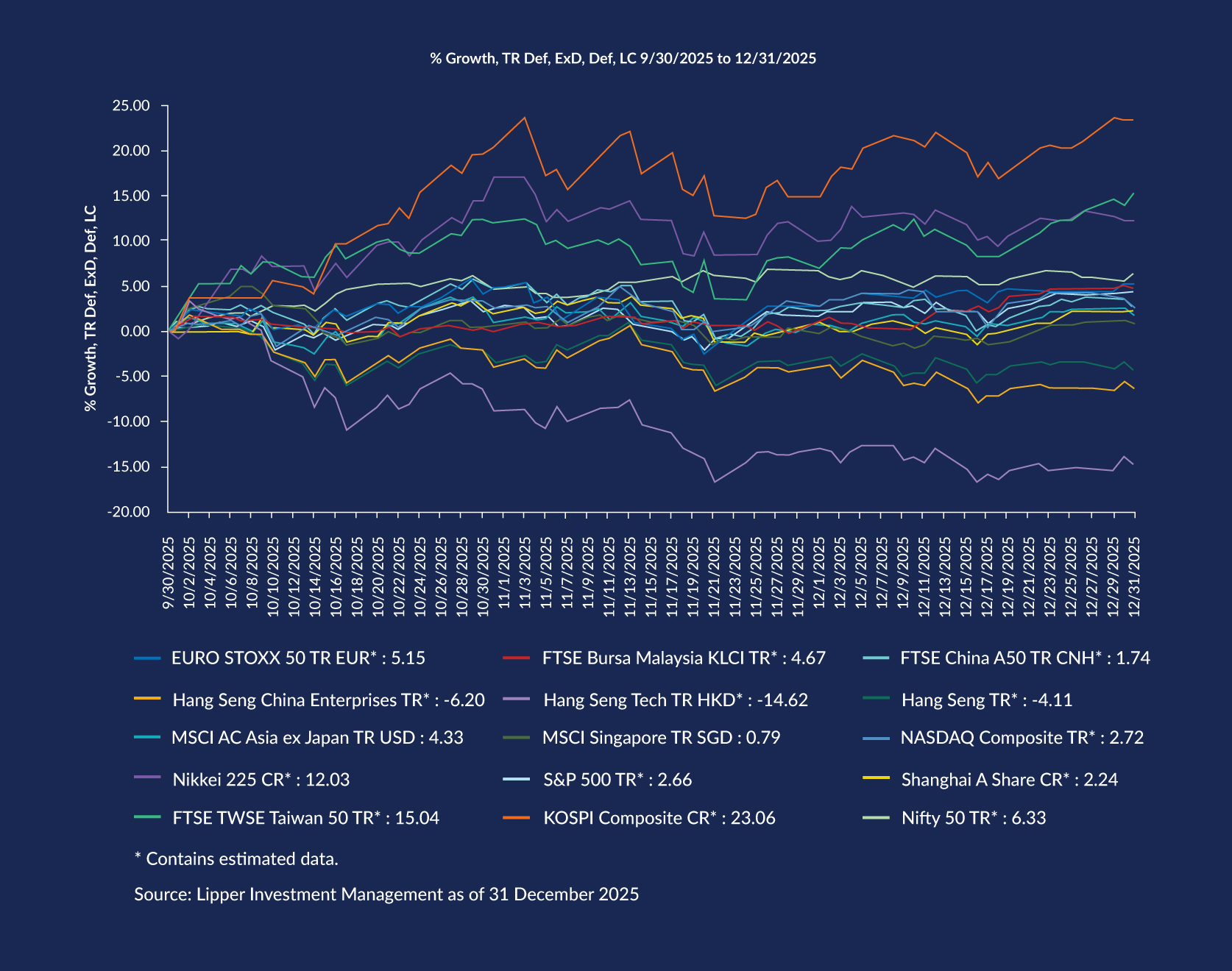
The final quarter of 2025 saw North Asian markets emerge as clear outperformers. South Korea’s KOSPI surged by 23%, followed by Taiwan at 15% and Japan at 12%, largely driven by sustained global demand for semiconductor and AI hardware. At the same time, Chinese markets struggled to gain momentum. Onshore A-shares recorded only modest gains, while offshore sentiment weakened significantly, pulling the Hang Seng Tech Index down nearly 15%. The darling of Asian markets lost its glow.
Interestingly, this period also reversed the usual Developed Market (DM) versus Emerging Market (EM) narrative. U.S. equities delivered relatively muted returns, with both the S&P 500 and Nasdaq rising about 2.7%, lagging behind the strong performance seen in parts of Asia.
Closer to home, ASEAN markets showed resilience. Malaysia’s FBM KLCI gained 4.67%, outperforming Singapore’s flat performance. This suggests investors were seeking stability and value amid regional volatility.
Malaysia Unit Trust Industry Fund Flows in Q4 2025
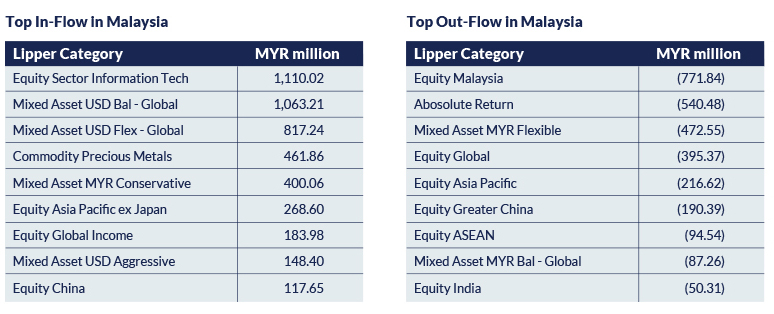
Investor behaviour often reveals market sentiment before headlines do. They felt the wind changing in Q4 2025 and adjusted their holdings. Fund flows showed a clear risk-on appetite, with strong allocations toward growth opportunities, while maintaining defensive positioning.
The Information Technology sector attracted the highest inflows, exceeding RM1.1 billion, reflecting continued confidence in long-term technology themes. At the same time, investors also allocated capital into Global Mixed Asset funds and Precious Metals. This dual positioning suggests investors were pursuing growth while hedging against uncertainty through diversification and safe-haven exposure. Despite the weak market performance, China equity funds still recorded positive inflows as some investors saw the opportunity to grab bargains. Malaysia-focused equity funds, however, experienced notable outflows. Investors started profit-taking following earlier gains, moving their capital toward faster-growing markets.
Performance of Key Unit Trust Funds in Q4 2025:
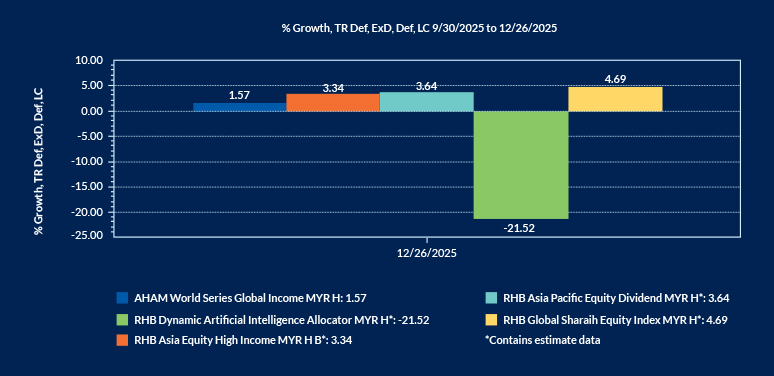
Overall, the previous quarter’s Fund Discovery recommendations reflected a disciplined, steady-hand approach. The RHB Global Shariah Equity Index Fund led performance with a 4.69% return, benefiting from diversified global exposure while avoiding concentrated volatility. Asia-focused income strategies, including RHB Asia Pacific Equity Dividend and RHB Asia Equity High Income, also did well, supported by North Asia’s strong rally.
One exception was the RHB Dynamic Artificial Intelligence Allocator Fund, which declined due to a correction in digital asset ETFs. While short-term performance was affected, the fund’s AI-driven allocation strategy is designed for long-term cycle management, so some patience is required.
As always, investments in higher-volatility thematic funds should reflect your risk tolerance and generally stay within 5–10% of your portfolio.
These are the three major themes shaping portfolio strategies in 2026:
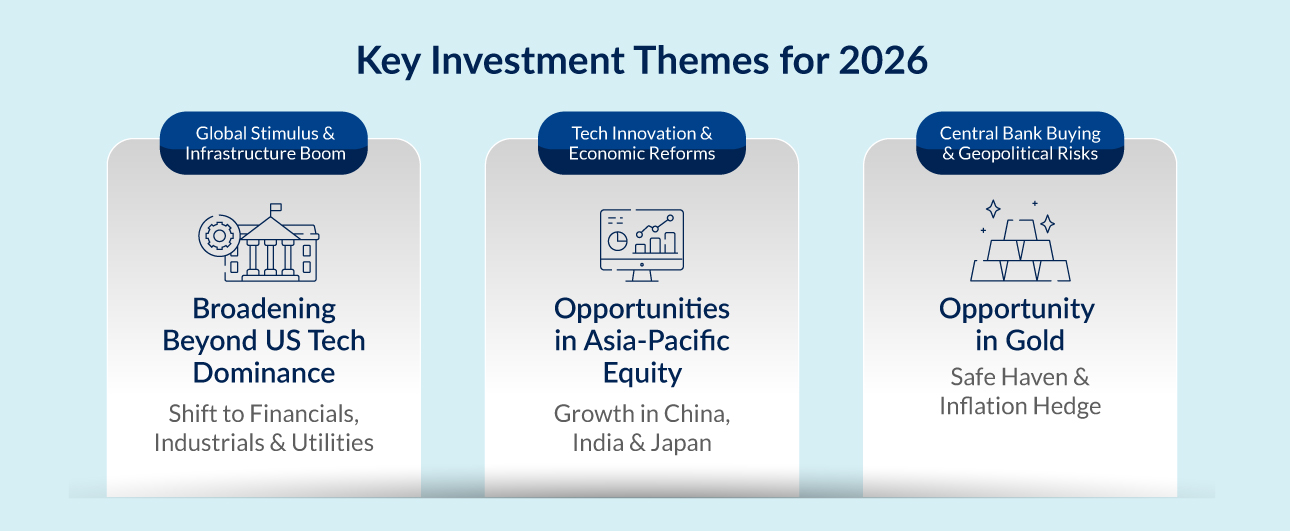
- Broadening Beyond U.S. Tech Dominance
It’s time to break away from the crowd. AI giants remain strong, but investors are becoming cautious about overconcentration and are rotating into sectors like financials, industrials and utilities.
This shift supports a more balanced global equity approach, particularly income-focused strategies that provide sustainable returns rather than relying solely on growth momentum. - Asia-Pacific’s Structural Opportunity
The grass is just as green on this side of the world. The Asia-Pacific region continues to present compelling long-term catalysts. - North Asia is advancing high-tech manufacturing.
- Japan and South Korea are implementing governance reforms aimed at improving shareholder returns.
- India remains one of the world’s fastest-growing major economies.
- Gold as a Strategic Hedge
Gold is regaining attention as central banks diversify reserves away from the U.S. dollar. Declining yields are also reducing the opportunity cost of holding the metal. Some market forecasts suggest gold prices could reach and stay at USD5,000 per ounce by the end of 2026, reinforcing its role as a structural portfolio hedge during uncertain cycles.
The Core-Satellite Strategy
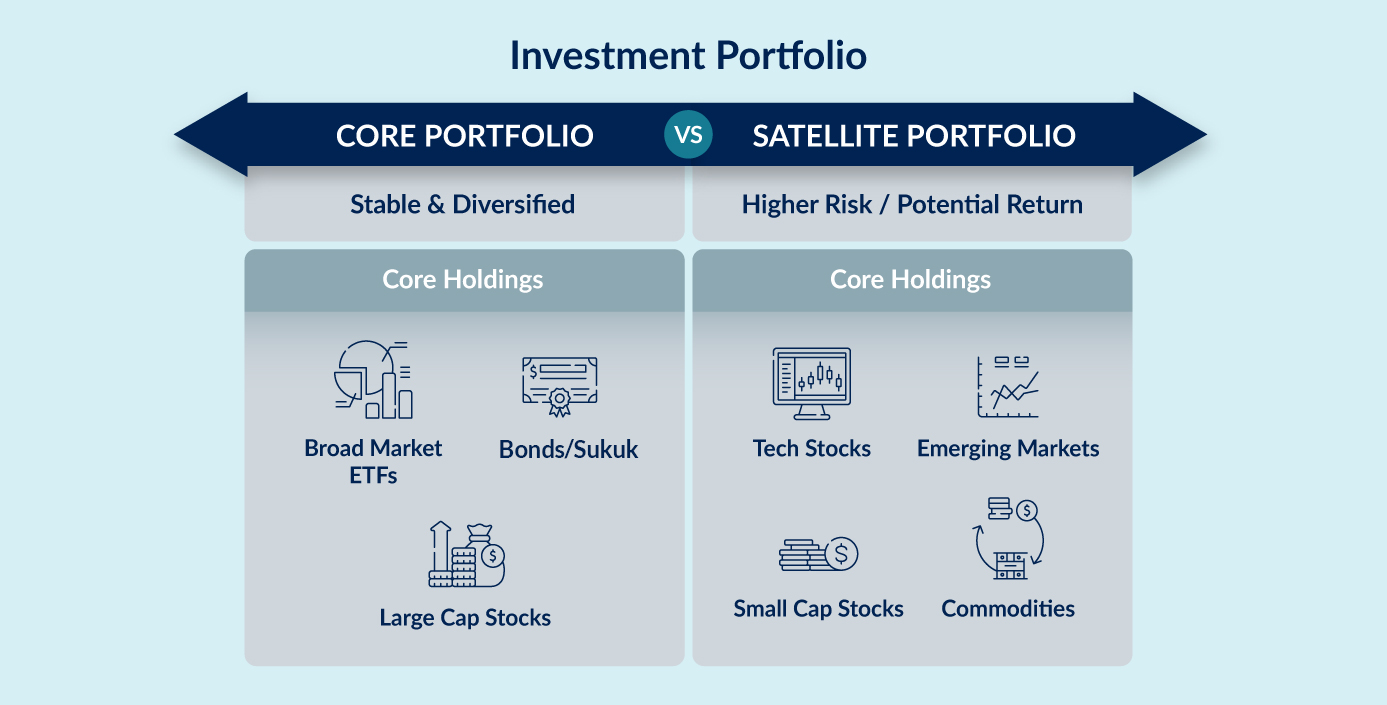
Given today’s complex environment, the Core–Satellite approach may help you structure your portfolio. Here’s how it works:
- The Core forms the foundation of the portfolio. Here’s where you park diversified investments aimed at long-term stability and income generation. Examples are broad global equity or income funds such as RHB Global Equity Premium Income, RHB Global Shariah Equity Index, or TA Total Return Income Fund that provide consistency across market cycles.
- The Satellite is a smaller allocation that’s more tactical. You target higher-growth opportunities or thematic trends, without increasing your overall portfolio risk too much. For instance, investors allocate into funds such as RHB i-Global Dividend, RHB Asia Pacific Dividend, or RHB Gold & General Fund.
This framework can potentially allow you to pursue growth while still maintaining balance and resilience.
RHB i-Global Dividend Fund
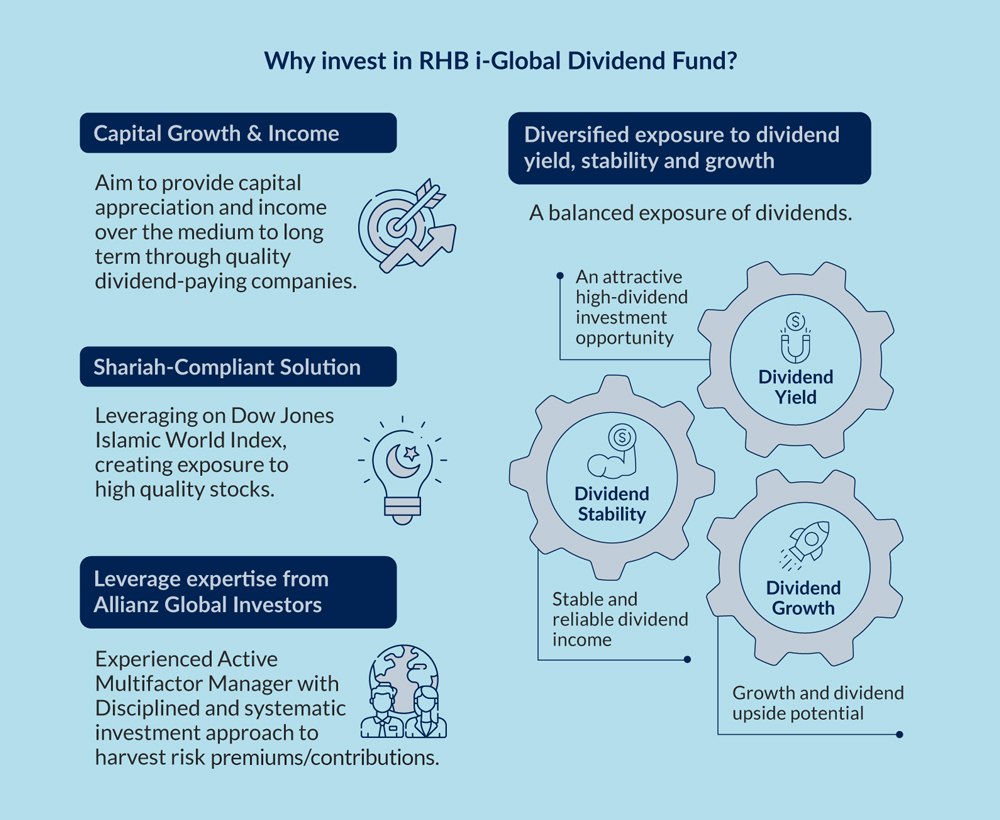
In a new reality of constantly shifting markets, consistency and stability matter. This fund focuses on Shariah-compliant global equities with strong fundamentals and sustainable dividend payouts. By leveraging systematic investment expertise, it seeks to generate income while maintaining disciplined risk management.
It may suit investors looking to enhance global income potential while maintaining diversification and ethical alignment.
RHB Asia Pacific Equity Dividend Fund
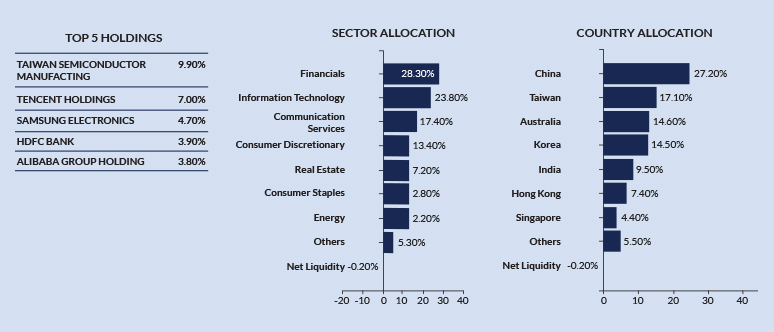
Designed to capture Asia-Pacific growth while prioritising income stability, this fund invests across markets such as Taiwan, China, and India.
Its combination of capital appreciation potential and regular income makes it a compelling satellite allocation for investors seeking regional diversification.
RHB Gold and General Fund
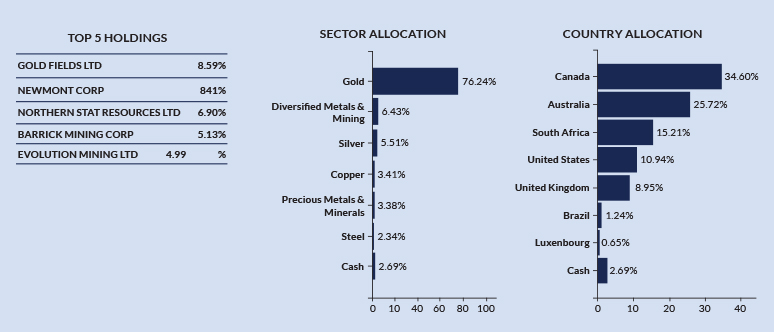
Providing equity exposure to global mining companies, this fund offers a differentiated participation in gold price movements.
Unlike physical bullion, gold miners benefit not only from rising gold prices but also from operational efficiencies and earnings growth, allowing investors to participate more broadly in gold upcycles.
If 2025 taught us anything, it is that markets no longer move as a single story. Regional divergence, shifting capital flows, and evolving economic dynamics require a more thoughtful approach to diversification.
So, rather than chasing short-term trends, a better approach would be to build a resilient portfolio grounded in a clear strategy. Balance stability through core holdings while actively pursuing opportunities through satellite allocations.
As 2026 unfolds ahead of us, discipline, diversification, and long-term perspective remain the most reliable investment tools. Speak to your Relationship Manager to review your portfolio and ensure it is positioned for maximum potential growth.

This article is strictly for its intended recipients and should not be copied, distributed or reproduced in whole or in part, nor passed to any third party, without obtaining prior permission of RHB Bank Berhad (“RHB”).
This article has been prepared by RHB and is solely for your information only. It may not be copied, published, circulated, reproduced, or distributed in whole or part to any person without the prior written consent of RHB. In preparing this presentation, RHB has relied upon and assumed the accuracy and completeness of all information available from public sources or which was otherwise reviewed by RHB. Accordingly, whilst we have taken all reasonable care to ensure that the information contained in this presentation is not untrue or misleading at the time of publication, we cannot guarantee its accuracy or completeness and make no representation or warranty (whether expressed or implied) and accept no responsibility or liability for its accuracy or completeness. You should not act on the information contained in this podcast without first independently verifying its contents.
Any opinion, management forecast or estimate contained in this article is based on information available as the date of this podcast and are subject to change without notice. It does not constitute an offer or solicitation to deal in units of any RHB fund and does not have regard to the specific investment objectives, financial situation or the particular needs of any specific person who may receive this. Investors may wish to seek advice from a financial adviser/unit trust consultant before purchasing units of any funds. In the event that the investor chooses not to seek advice from a financial adviser/unit trust consultant, he should consider whether the fund in question is suitable for him. Past performance of the fund or the manager, and any economic and market trends or forecast, are not necessarily indicative of the future or likely performance of the fund or the manager. The value of units in the fund, and the income accruing to the units, if any, from the fund, may fall as well as rise.
Product Highlights Sheets (“PHS”) highlighting the key features and risks of the RHB i-Global Dividend Fund dated 12 December 2025, RHB Dynamic Artificial Intelligence Allocator Fund dated 17 March 2025, RHB Global Shariah Equity Index Fund dated 16 February 2024, TA Total Return Income Fund dated 23 May 2025, RHB Asia Pacific Equity Dividend Fund dated 22 January 2024, RHB Gold and General Fund dated 29 August 2025 and RHB Global Equity Premium Income Fund dated 8 January 2025 (“Fund”) are available and investors have the right to request for a PHS.
Investors are advised to obtain, read and understand the PHS and the contents of the Information Memorandum and its supplementary (ies) (if) (“the Information Memorandum”) before investing. The Information Memorandum has been registered with the Securities Commission Malaysia (“SC”) who takes no responsibility for its contents. The SC’s approval and authorization of the registration of the Information Memorandum should not be taken to indicate that the SC has recommended or endorsed the Fund. Amongst others, investors should consider the fees and charges involved. Investors should also note that the price of units and distributions payable, if any, may go down as well as up. Where a distribution is declared, investors are advised that following the issue of additional units/distribution, the NAV per unit will be reduced from cum distribution NAV to ex-distribution NAV. Any issue of units to which the Information Memorandum relates will only be made on receipt of a form of application referred to in the Information Memorandum. The printed copy of prospectus and Product Highlight Sheet is available at RHB branches/Premier Centre and investors have the right to request for a Product Highlight Sheet. Investors are advised that investments are subject to investment risk and that there can be no guarantee that any investment objectives will be achieved. Investors should conduct their own assessment before investing and seek professional advice, where necessary and should not make an investment decision based solely on this update.
The Manager wishes to highlight the specific risks of the RHB i-Global Dividend Fund, which are Shariah-Compliant Equity Risk, Shariah-Compliant Equity-Related Securities Risk, Currency Risk, Country Risk, Concentration Risk, Reclassification of Shariah Status Risk, Risk of Investing in Emerging Markets, Company Specific Risk, and Distribution Out of Capital Risk. The specific risks of the RHB Dynamic Artificial Intelligence Allocator Fund are Liquidity Risk, Currency Risk, Country Risk, Interest Rate Risk, Credit and Default Risk, Financial Derivatives Risk, Equity Risk, Equity-Related Securities Risk, Collective Investment Schemes Risk, Concentration Risk, Distribution Out of Capital Risk, and Risk of Over-Reliance on the Artificial Intelligence Risk Model. The specific risks of RHB Global Shariah Equity Index Fund are Management Risk, Liquidity Risk, Currency Risk, Country Risk, Market Risk, Emerging Markets Risk, Foreign Exchange Risk, Shariah Restrictions Risk, Stock Risk, Liquidity Risk, Risks Associated with Government or Central Banks' Intervention, Prohibited Securities Risk, Taxation Risk, Risks Relating to the Index, Counterparty Risk, Index Tracking Risk, Operational Risk, Corporate Actions Risk, Custody Risk, Reliance on Third Party Data Providers, Cyber Security Risk, Pandemic Risk, Exchange Rate Risk, and Investment Leverage Risk. The specific risks of TA Total Return Income Fund are External Investment Manager’s Risk, Currency Risk, Currency risk at the hedged Class level, Currency risk at the non-hedged Class level, Liquidity Risk, Derivatives Risk, Counterparty Risk, Commodities Risk – Gold, Collective Investment Scheme Risk, Underlying fund risk, Concentration Risk, Multiple Levels of Expenses, Risks of Investing in ETFs, Temporary Suspension of the Collective Investment Schemes Risk, and Distribution Out of Capital Risk. The specific risks of RHB Asia Pacific Equity Dividend Fund are Management Risk, Liquidity Risk, Currency Risk, Country Risk, Interest Rate Risk, Investment risk, Equity risk, Political, Economic and Social Risks, Market Risk, Dividend-paying Equity Risk, Emerging Markets Risk, Concentration Risk, Smaller Companies Risk, Risk Associated with High Volatility of the Equity Market in the Asian Region, Hedging Risk, Derivatives Risk, Leverage Risk, RMB Currency Risk, Real Estate Investment Trusts (REITs) Risk, Special Purpose Acquisition Company (SPAC) risk, Payment of Distributions Out of Capital Risk, Low Level of Monitoring Risk, Legal, Tax and Regulatory Risk, Valuation Risk, Volatility Risk, Custodial Risk, Counterparty Risk, People’s Republic of China (PRC) Tax Risk Consideration, Early Termination Risk, Technology Related Companies Risk, Cross-Class Liability Risk, China Market Risk, Risk Associated with Foreign Shareholding Restrictions on China A-Shares, Risk Associated with Short Swing Profit Rule, Risks Associated with China Connect, Risks Associated with the Investments in Stocks Listed on the Beijing Stock Exchange and/or the ChiNext Board of the SZSE and/or the Science and Technology Innovation Board (“STAR Board”) of the SSE, Risks Associated with Equity-linked Notes and Participation Notes, Risks Associated with Collateral Management and Re-investment of Cash Collateral, London Interbank Offer Rate (“LIBOR”) Discontinuance or Unavailability Risk, and Chinese Variable Interest Entity Risk. The specific risks of RHB Gold and General Fund are Market risk, Foreign exchange and currency risk, Political, regulatory and legal risk, Derivatives risk, Liquidity risk, Small and medium capitalisation companies risk, Commodities risk, Broker risk, Counterparty risk, Equity securities risk, Investment management risk, Risk of using rating agencies and other third parties, and Concentration risk. The specific risks of RHB Global Equity Premium Income Fund are Fund Management Risk, Liquidity Risk, Currency Risk, Country Risk, Interest Rate Risk, Suspension of Redemption Risk, Distribution out of Capital Risk, Availability of Investment Opportunities Risk, Balance Sheet Risk, Cash Positions and Temporary Defensive Positions Risk, Collection Account Risk, Collateral Risk, Costs of Buying or Selling Shares Risk, Counterparty Risk, Currency Risk, Cyber Security Risk, Liquidity Risk, Listing Risk, Market Risk, Political and/or Regulatory Risk, Risks in relation to Equity Securities, Particular Risks of Exchange Traded Derivative Transactions, Particular Risks of Over-the-counter Derivative Transactions, Investment in Emerging and Less Developed Markets Risk, Investment in Real Estate Investment Trusts Risk, Derivative Risks, Settlement Risk, Short Selling Risk, Warrants Risk, Dividends Risk, Fluctuation of NAV and Market Pricing Risk, Indemnification Obligations Risk, Legal Risk – Over-the-counter Derivatives, Reverse Repurchase Transactions, Securities Lending and Re-used Collateral, Secondary Market Trading Risk, Securities Lending Risk, Suspension of Share Dealings Risk, Tax Risk, Underperformance Risk, Volcker Rule Risk, Sustainability Risk and other general risks are elaborated in the Information Memorandum. This article has not been reviewed by the Securities Commission Malaysia (SC).
RHB Bank Berhad 196501000373 (6171-M) | RHB Islamic Bank Berhad 200501003283 (680329-V)
